REVIEW · MEXICO CITY
Gay Side of History through Plazas & Temples
Book on Viator →Operated by Mex at Max · Bookable on Viator
Mexico City tells its LGBTQ+ story in plazas. This guided route connects major landmarks like Templo Mayor and the Zócalo with the people, policies, and everyday lives behind them. You also get digital tools you can take home, so the sites stick in your mind.
I love the personalized small-group pace (maximum 10 people) and the fact that the guide keeps it human, not just dates. I also love the start at Librería Porrúa, where coffee comes with a rooftop view over the ruins and surrounding historic buildings.
One consideration: you’ll walk about 1 mile in roughly 3 hours, and the story includes heavy stuff, like how the Spanish Inquisition targeted gay men.
In This Review
- Key highlights you’ll feel right away
- Rooftop coffee at Librería Porrúa and the view that sets the tone
- Great Temple ruins, then the Catholic Cathedral’s long shadow
- Zócalo and the National Palace: where politics meets identity
- Centro Cultural de España and the preserved city behind the Cathedral
- Plaza de Santo Domingo: Portal de Evangelistas, the Inquisition, and a gay male path
- Carlos’s guide style, plus why the digital map and PDFs actually help
- Price and value: what $99 buys you in Mexico City
- Who should book this tour, and who may want a different pace
- Should you book Gay Side of History through Plazas & Temples?
- FAQ
- How long is the Gay Side of History through Plazas & Temples tour?
- What does the tour cost?
- What’s included in the tour?
- What language is the tour offered in?
- How big is the group?
- Where does the tour start and end?
- Is the tour wheelchair-accessible?
- What should I know about animals and weather?
- What is the minimum age to join?
Key highlights you’ll feel right away
- Rooftop start at Librería Porrúa with coffee and big views over Templo Mayor ruins
- Max 10-person group for questions and a pace that doesn’t feel rushed
- Digital LGBT+ map + extra resources so you can keep exploring after the tour
- PDF ebook download (RAINBOW MEXICO) to extend the learning at your own speed
- Walk through the Historic Center’s power grid: Aztec roots, colonial Catholic rule, and modern politics
- Plaza Santo Domingo + Portal de Evangelistas for history you can actually watch in motion
Rooftop coffee at Librería Porrúa and the view that sets the tone
The tour kicks off in a place that feels made for slowing down: the rooftop balcony at Librería Porrúa. You start with coffee and/or tea, and that first cup matters. It gives you a calm landing before you zoom into centuries of change.
From up high, you’re looking at layers of Mexico City at once—ruins of the Great Aztec Temple (Templo Mayor), the surrounding historic buildings, and even references to the famous Frida Kahlo area nearby (the tour points you toward those locations from the roof). It’s a smart way to train your eyes. Instead of arriving at ruins cold, you understand where everything sits in relation to everything else.
This first stop also buys you time. You get about an hour here, including the rooftop access. That extra time is part of the value of this tour: you’re not just “passing by” a viewpoint—you’re using it to build context.
And yes, the view is good for photos, but the bigger win is mental. You’ll walk a route that starts to make sense as a connected story, not separate stops.
You can also read our reviews of more historical tours in Mexico City

Great Temple ruins, then the Catholic Cathedral’s long shadow
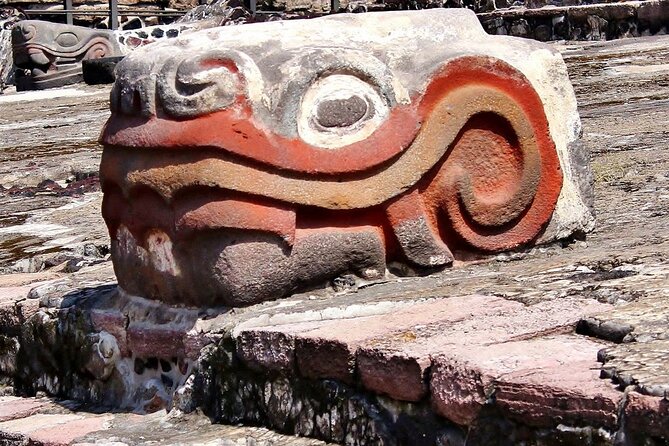
After that rooftop warm-up, the tour moves into Templo Mayor, the main temple of the Mexica (what many people call the Aztecs) in their capital city. This is where the physical city starts doing the talking. The ruins and their placement help you picture how sacred space sat at the center of power.
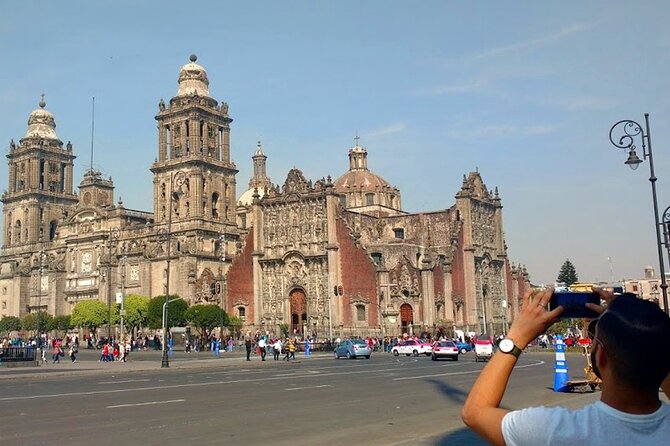
Then you head to the Metropolitan Cathedral of the Assumption of the Most Blessed Virgin Mary into Heaven. The Cathedral isn’t just a beautiful church. It’s the symbol of a new authority system replacing an older one. Seeing it right after the Templo Mayor context makes the contrast hit harder—in a good way.
This is also where the guide’s approach really helps. I like tours where you get a few minutes of context before you’re expected to process what you’re looking at. Here, the pacing makes you feel like you’re building meaning step by step, not grabbing random facts while walking.
One practical note: these are big, important landmarks, so there can be crowds around. If you’re photo-focused, go a half-step slower and give yourself time to find a clean angle before moving on.
Zócalo and the National Palace: where politics meets identity
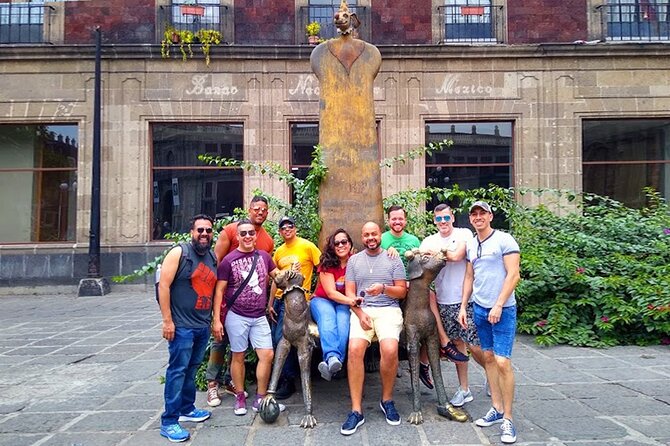
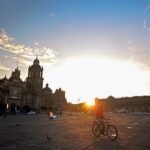
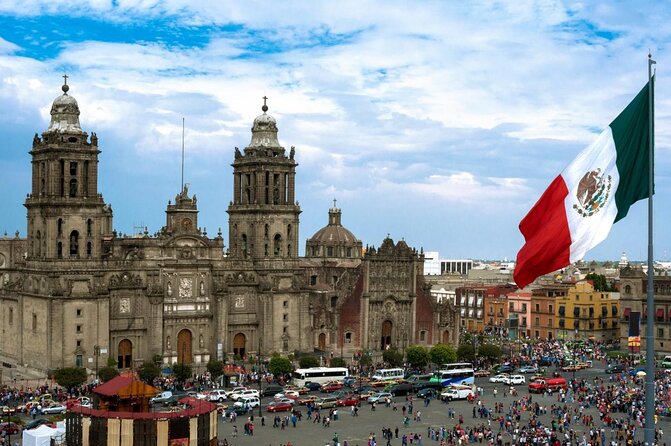
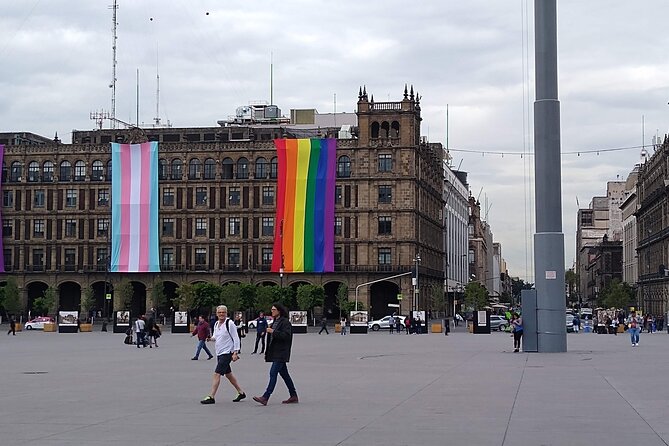
Next up is the Zócalo, Mexico City’s central plaza. It’s the heart of the city and the meeting place that’s been around since the 16th century. Standing here, it’s easier to understand why so many stories—celebration, protest, control—play out in public space.
The tour keeps the momentum by linking the plaza to the National Palace (Palacio Nacional), seat of the federal executive. Since 2018, it has also served as the official residence for the President of Mexico. That modern detail matters because it shows how the same kind of “power geography” keeps returning, just under different systems.
What I appreciate is that this isn’t a “politics only” walk and it isn’t a “LGBTQ+ only” walk. The route uses the public stage—the plaza and the government space—to show how laws, institutions, and social realities shape what people can live out openly.
You also get a short stop here (about 30 minutes). It’s long enough to orient yourself and feel the scale, without turning the tour into a slow shuffle.
Centro Cultural de España and the preserved city behind the Cathedral
The next stop is the Centro Cultural de España en México, on Guatemala Street, just behind the Cathedral area. This place has a restoration story that adds texture to what you’re seeing. The building was once in ruins, then the Mexico City government ceded it to Spain, and it reopened as a cultural center in 2002.
Even when you’re not inside, the location helps. You’re standing where a city government and international partnership reshaped an old mansion’s fate. That matters in a tour about LGBT+ history because identity isn’t just a personal story—it’s also influenced by institutions, property, and what gets restored or erased.
You also pass by the Old Customs Building, situated near Santo Domingo Plaza. Custom houses and trade routes may not sound like “LGBTQ+ history,” but this tour treats the city like a system. Movement of goods, movement of people, and movement of information all connect to who had safety, who had opportunity, and who had surveillance.
This segment is about noticing the quiet streets and the edges of the big monuments. You’ll see how the historic center works like a web. One stop leads to the next because the city was planned to channel movement.
Plaza de Santo Domingo: Portal de Evangelistas, the Inquisition, and a gay male path
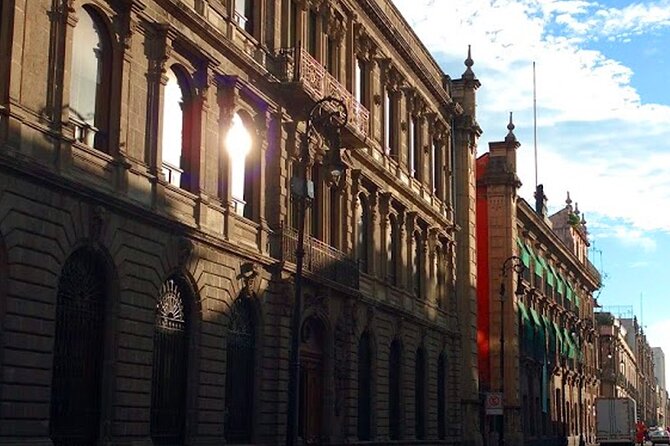
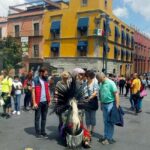
Then comes Plaza de Santo Domingo, with time to take it in (about 30 minutes). The square is flanked by the Portal de Evangelistas, a Tuscan colonnade with round arches. The tour points out scribes working with typewriters and antique printing machines. That’s a wonderfully specific detail—this isn’t only history you read. It’s craft and trade still happening in a very old frame.
On the subject of the Inquisition: the tour includes the Spanish Inquisition as the civilian institution that executed convicted homosexuals from 1521 to 1821. That’s presented as part of the historical structure behind what people could and couldn’t do. It’s not shocking for the sake of shock. It helps explain why legal and religious power had consequences on intimate life.
On the north side of the plaza is the Church of Santo Domingo. The tour connects this area to El Camino Real, a trading route from Old Mexico to New Mexico, described as a safe haven for gay male couples. Whether you agree with every interpretation or not, the point is clear: routes, meeting points, and small social spaces can matter just as much as laws.
You finish the tour at the Antiguo Palacio de la Santa Inquisición—an ending that lands like a full stop. It gives you a sense of closure to the theme. The story comes back to the place where persecution was organized, not just discussed.
This final stretch is where the tour turns from “places” into “meaning.” If you’ve been enjoying the architecture and the dates, you’ll still get that—but you’ll feel the weight of the theme.
You can also read our reviews of more tours and experiences in Mexico City
Carlos’s guide style, plus why the digital map and PDFs actually help
A lot of tours hand you a brochure and hope you remember it later. This one gives you tools you can use.
You get a digital LGBT+ map of the Historic Center, plus extra resources. That’s useful because the route is in a dense area. After the tour, you can reopen the map and choose what to revisit without starting from zero. You also get a downloadable PDF copy of RAINBOW MEXICO: Bridging Forgotten Pasts and Vibrant Futures. That ebook download turns the tour into a beginning, not a one-time event.
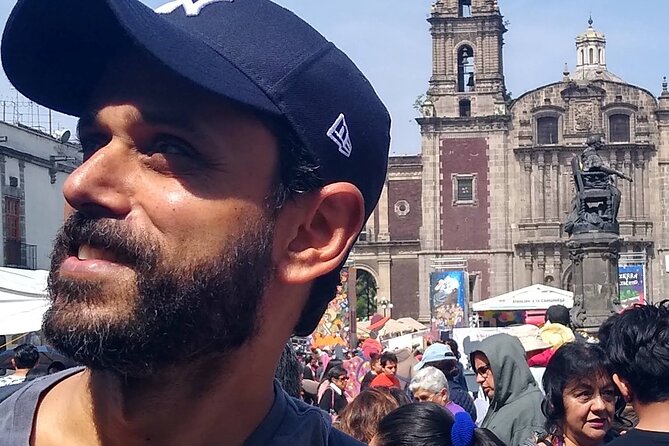
Then there’s the human part. In many experiences, the guide is the difference between “information” and “understanding.” This tour’s guide, Carlos, has a reputation for storytelling that stays engaging even when the topic is serious. I like when a guide gives context right before you reach a site, because your brain needs a framework to process what you’re seeing.
Carlos is also described as asking about personal interests and working those into the walk. That’s a big reason the tour feels personalized even with a group setting. With a maximum of 10 people, you get enough space for questions without derailing the schedule.
One more small but practical bonus: one review mentions Carlos providing a link to his detailed website with notes and details of the tour. If you like to read more afterward, that matters.
Price and value: what $99 buys you in Mexico City
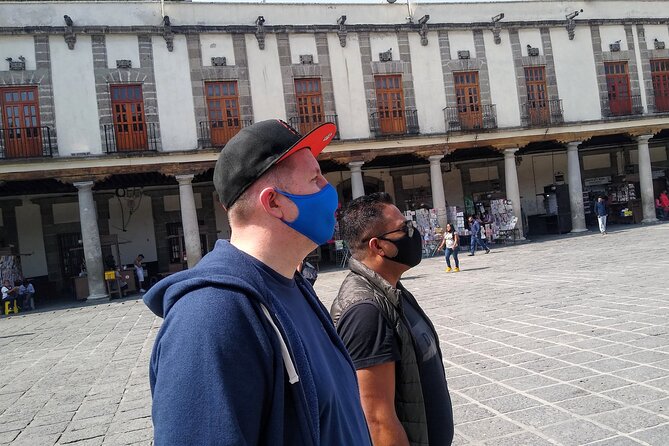
At $99 per person for about 3 hours 30 minutes, this tour isn’t a bargain snack. It’s a purposeful, guided learning experience. Here’s why the price can make sense.
You’re not paying only for a route. You’re paying for:
- A local guide who frames what you see
- Coffee and/or tea plus bottled water
- A digital LGBT+ map and extra resources you can use later
- PDF ebook downloads you can revisit
- Small-group size (max 10), which usually means better attention and less time stuck behind other people
There’s also ticket value baked into it. The rooftop stop at Librería Porrúa includes an admission ticket. Some of the major landmarks on the route are free to enter (the Zócalo, the Centro Cultural de España, and Plaza Santo Domingo), but you’re paying for the guided interpretation and the access component at the start.
If you’re trying to decide between a cheaper walk and this one, I’d weigh your goal. If you want a fast overview, you can find simpler tours. If you want a focused LGBTQ+ history route that helps you connect the sites—and you like having digital resources afterward—this price starts looking reasonable.
Who should book this tour, and who may want a different pace
This is ideal if you:
- Want LGBTQ+ history in Mexico City’s core without guessing what connects each stop
- Like walking through real landmarks in a tight time window
- Appreciate when the guide explains context before you look
- Are okay with a topic that includes persecution and legal/religious power
You might want a different style of tour if you:
- Prefer long museum time over a walking route
- Get uncomfortable with heavy historical topics around the Inquisition
- Want a light, playful theme only
Also, plan for weather. It operates in all conditions, and the tour suggests dressing appropriately. The walking portion is about 1 mile, so it’s not a marathon, but you’ll still want comfortable shoes.
Should you book Gay Side of History through Plazas & Temples?
If you’re building your first or second day in Mexico City’s Historic Center and you care about seeing more than postcard scenes, I think this tour is a strong pick. The rooftop start at Librería Porrúa sets up the whole story, and the route keeps you moving through places that explain how power, religion, law, and public space shaped LGBTQ+ lives.
For $99, you’re getting more than a walk. You’re getting a guided narrative, plus a map and PDFs you can revisit when you’re back in your hotel. Just be ready for serious history, and wear shoes that can handle old-stone sidewalks.
If you do book it, I’d suggest setting aside time afterward for a drink near the Zócalo or a slow read through the PDF. This one rewards follow-through.
FAQ
How long is the Gay Side of History through Plazas & Temples tour?
It runs for about 3 hours 30 minutes.
What does the tour cost?
The price is $99.00 per person.
What’s included in the tour?
You get a local guide, coffee and/or tea, bottled water, a digital LGBT+ map of the Historic Center with extra resources, and downloadable PDF copies of the ebook RAINBOW MEXICO. A ticket at the Librería Porrúa rooftop stop is also included.
What language is the tour offered in?
The tour is offered in English.
How big is the group?
The maximum group size is 10 travelers.
Where does the tour start and end?
It starts at República de Argentina 15, Centro Histórico de la Cdad. de México, Centro, Cuauhtémoc, 06020, Ciudad de México, CDMX, Mexico. It ends at Antiguo Palacio de la Santa Inquisición, República de Brasil 33, Centro Histórico de la Cdad. de México, Cuauhtémoc, 06020, Ciudad de México, CDMX, Mexico.
Is the tour wheelchair-accessible?
The provided information doesn’t state wheelchair accessibility. It does note that travelers should have a moderate physical fitness level and that you will walk about 1 mile in 3 hours.
What should I know about animals and weather?
Service animals are allowed, and the tour operates in all weather conditions, so you should dress appropriately.
What is the minimum age to join?
The minimum age is 18 years.